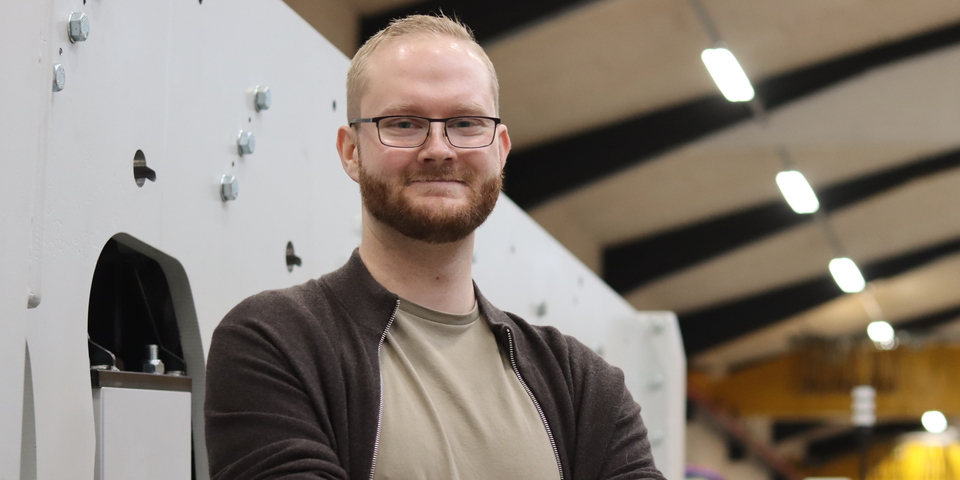
A nine-metre-long machine takes up considerable space in the hall. Seven metres wide, five metres high. Steel, sensors and motors. “I designed that one,” Mickey says. “It’s fascinating to see something you’ve had on your computer screen suddenly exist in real life.”
He graduated as a mechanical engineer from VIA University College a year and a half ago. Today, he works at SYSTEM TM, a company that produces customised machines for the timber industry. His role involves developing and adapting specialised machinery – from the initial calculations and 3D designs to assembly, testing and installation.
But the fascination began long before that.
A fascination with things that move
“I’ve always been fascinated by how the world works. I love mechanics – things that move,” he explains. As a child, he wanted to become a particle physicist, and in upper secondary school he considered studying electrical engineering. That passion still remains as a hobby.
However, it was the combination of calculations, design and real-world construction that led him to mechanical engineering – along with the scale of the work. “You can tinker with electronics as a hobby. It’s a bit harder to build a huge machine in your back garden,” he says with a smile. “And there’s just something exciting about creating something so big.”
Close interaction with lecturers
He chose to study in Horsens partly because the study environment felt manageable and supportive. There was room for questions, dialogue and discussions with lecturers who had industry experience. All of this made a big difference to him.
“I liked that there weren’t a hundred people sitting in a lecture theatre like at university. There was time to ask questions and discuss things with the lecturers.” This environment also helped link theory and practice. “It makes a difference when a lecturer can say: this is what it says in the textbook – but in practice, we do it like this.”
This approach is something Mickey has carried with him into his professional life.
From sketch to reality
Today, Mickey’s work involves developing new machines and adapting existing ones. A typical process begins at the computer, where designs/structures/constructions are dimensioned and documented. Later, the parts are manufactured elsewhere and then delivered to his workplace for assembly and testing.This is where theory and practice become reality – where a sketch on a screen becomes something tangible. It feels almost like magic.
“The first time I saw something I had designed assembled in the workshop – I’ll never forget that feeling. Not just seeing it there, but also the tension of whether something that worked perfectly on a computer screen would work just as well in real life. Thankfully, it did,” Mickey recalls.
But the work often continues even after the machine is assembled. Final details frequently emerge during testing or once the machine is in operation at the customer’s site. Adjustments may be needed, or improvements identified. For Mickey, this is part of what makes mechanical engineering so exciting. “I think it’s exciting when a problem arises – then we have to find a solution.”
Being a bit of a geek is part of the package
According to Mickey, you need to have a natural problem-solving mindset to be a mechanical engineer. The role requires a wide range of competences: working with 3D software, understanding pneumatics, risk assessment and safety – and not least the ability to dive deep into technical details while maintaining an overview of the bigger picture.
He is keen to be honest about this when speaking to prospective students: “You should be prepared for the technical part of the degree. It’s not just about being able to draw – it’s about understanding, calculating and designing. If you only want to draw, there are other programmes better suited to that. But if you enjoy exploring details, understanding how things connect, and seeing your ideas become reality, then a mechanical engineering degree opens many doors.” These doors can lead to careers in development, production, optimisation, project management and technical consultancy – in both small companies and international organisations.
Mickey has already opened one of those doors. Who knows which ones he will open in the future? For him, it is the combination of curiosity and responsibility that drives him. He wants to keep learning. He wants more responsibility. He wants to take on challenges that are not yet solved.
And when a nine-metre-long machine stands completed in the hall, running exactly as it should – he knows he made the right choice.