1st semester – Mechanics and technical documentation
At the first semester, you will build a strong foundation as a mechanical engineer.
You work with mechanics, mathematics, and technical documentation and learn how to describe and document technical solutions correctly and professionally.
You will also be introduced to the digital tools and working methods used by engineers in industry, which form the basis for the rest of the programme.
- Semester courses: Mechanics (MEC1), Materials and manufacturing technologies (MMT1), Technical design (TDE1), Automation and digitalisation (AUP1), and workshop training in metalworking.
- Examples of semester projects (SEP1):
- Design of a gripping tool that makes it possible to lift and place heavy concrete blocks
- Development of a mobile lifting platform that makes servicing and repairing ATVs easier and more ergonomic
- Design of a tool that can accurately lift and position heavy granite curd stones
- Design of an aid that makes the transport and lifting of heavy tree trunks easier
2nd Semester – Machine design and materials
At the second semester, you work with the design and dimensioning of machines and mechanical structures.
You learn to select materials based on their properties and applications and to combine strength calculations with practical design considerations.
The semester builds on fundamental mechanical principles and applies them in a more practical context through concrete design and construction tasks.
- Courses in this semester: Mechanics (MEC2), Materials, Technologies and environment (MTE2), Dynamics (DYN1), Mathematics (MAT1), and workshop training in CNC machining and 3D scanning.
- Examples of semester projects (SEP2):
- Design of a height-adjustable shelf that improves ergonomics in high kitchen cabinets
- Construction of a lifting system that makes the handling of drones safer
- Design of a machine that can extract seeds from plants quickly and efficiently
3rd Semester – Machine elements and electrical engineering
During the third semester, you work with machine elements and technical systems involving mechanics, motion, and electrical components.
You learn to analyse and assemble machine components into functional systems and gain an understanding of the interaction between mechanical and electrical solutions in machines and installations.
- Courses in this semester: Machine elements and machine design (MEM1), Electrical engineering (ELE1), Dynamics (DYN2), Mathematics (MAT2), and workshop training in electrical engineering and hydraulics.
- Examples of semester projects (SEP3):
- Development of a portable cable stripper that enables insulation removal on-site and recycling of copper
- Design of an assistive device for hospital beds that makes turning bedridden patients easier and more ergonomic
- Design of a machine that converts discarded 3D prints into new filament for 3D printers
- Construction of a robotic tool that enables handling and rotation of metal plates in an automated press brake
4th Semester – Automation, energy and business
At the fourth semester, you work with control systems, automation, and energy in technical systems.
You learn to apply automatic control systems to regulate processes and optimise operation and energy consumption.
At the same time, you gain insight into business and project-related aspects, ensuring that technical solutions can function in a real-world business context.
- Courses this semester: Automatic machine systems (AUT1), Thermodynamics (TER1), Strength analysis and simulation (FEM1), Economics (ECE1), and workshop training in energy systems and robotics.
- Examples of semester projects (SEP4):
- Development of an energy solution for army night combat equipment, reducing the need for disposable batteries through rechargeable batteries and solar cells
- Analysis of energy solutions for single-family houses, comparing heat pumps and solar systems with district heating, focusing on cost-effectiveness and energy efficiency
- Development of an automated greenhouse where solar cells power ventilation and control the indoor climate
- Design of a heat recovery system for fireplaces that utilises exhaust gas heat to improve energy efficiency in homes
5th Semester – Internship
The fifth semester consists of an internship in a company, where you work with real-life engineering tasks.
You gain the opportunity to apply your professional knowledge in practice and become part of a professional workplace.
Yor internship will give you experience with collaboration, responsibility, and everyday engineering work. Many students also secure student jobs or their first full-time position through their internship.
6th–7th Semesters – Specialisation and bachelor project
In the final semesters, you specialise through elective courses and a major bachelor project.
The elective courses allow you to tailor your education to specific interests, for example within renewable energy, artificial intelligence, innovation, or advanced calculations.
The bachelor project brings together the knowledge gained during the programme and demonstrates your ability to independently solve a complex engineering problem – often in collaboration with a company.
- Courses in these semesters: Innovation and entrepreneurship (IDE1), Dynamic systems (DSM1), Internet of things (IOT1), Bachelor project, and elective courses.
- Examples of bachelor projects:
- Development of a simulation model for snap-fit joints at LEGO, reducing the need for physical prototypes in product development
- Automation of soldering processes at VOLA to improve production quality and efficiency
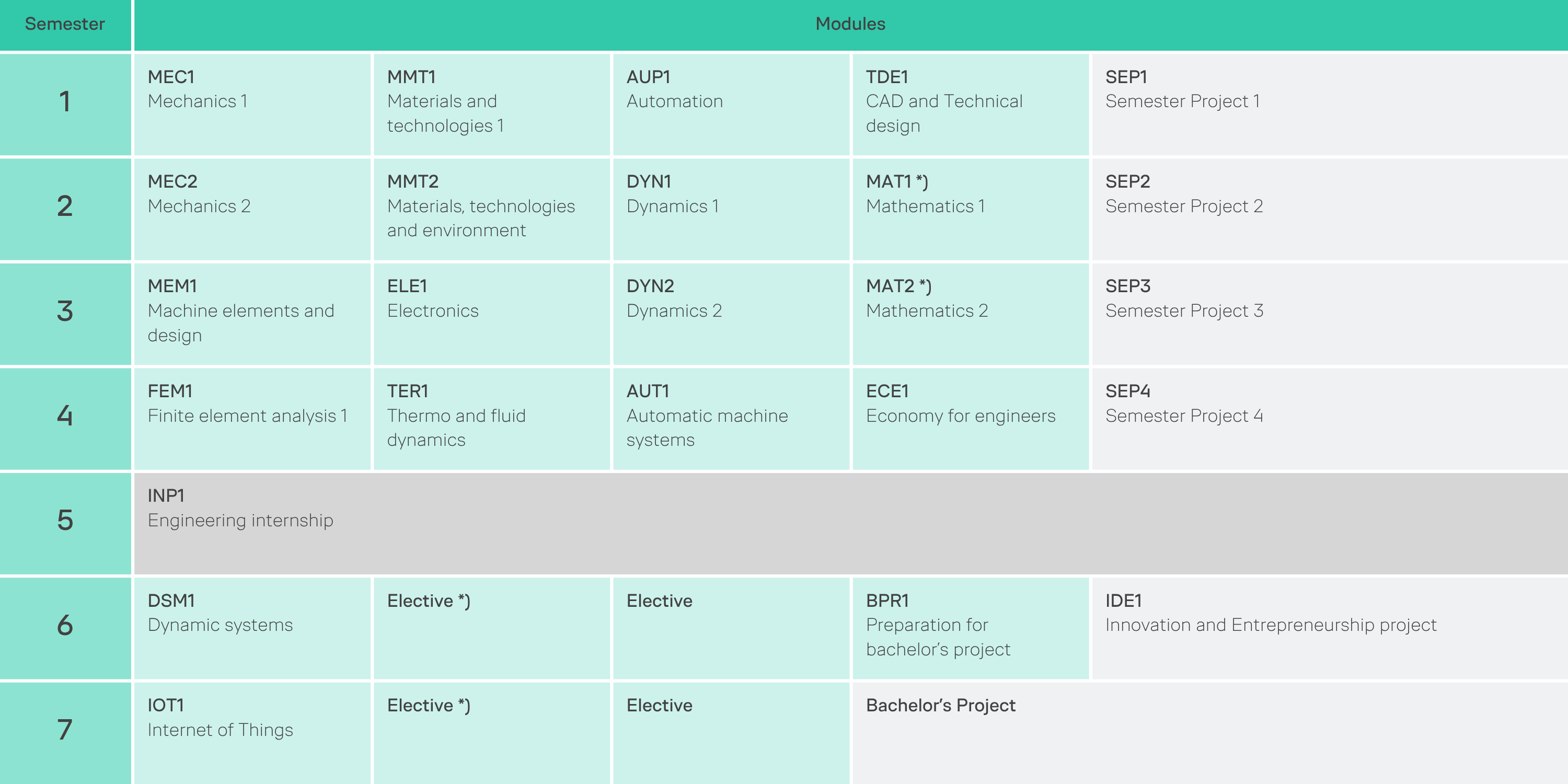
*) Courses marked with * are part of the specialisation Mathematical Methods. Elective courses in the 6th and 7th semester are replaced by the mandatory specialisation courses Advanced Engineering Mathematics and Advanced Linear Algebra.