Software Technology Engineering - Cybersecurity specialisation

At the Cybersecurity Engineering programme, you will work with programming, system development, and the design of secure digital solutions. You will learn to develop software from scratch and gain deep insight into how modern software systems are built, connected, protected, and maintained.
Detaljebillede af computer i en undervisningssituation. Neonlys, computer, bærbar, skærm, gruppearbejde, briller, kodning, teknologi.

Type

Bachelor of Engineering

Duration

3 years, 6 months

Campus City

Horsens

Study start

February

Internship

20 weeks

Enrolment and admission requirements

To be enroll in the Cybersecurity Engineering study programme, you must fulfil the admission requirements. Applicants with foreign diplomas must apply by 15 March at 12.00 noon.

  • Admission requirements - one of the following

    • Upper secondary school leaving certificate/high school exam or
    • The International and the European Baccalaureates or
    • Danish Admission course for Engineering programmes

    Specific admission requirements

    In addition to the admission requirements, all applicants must also meet the following specific admission requirements:

    • Mathematics equivalent to a Danish A-level
    • Physics equivalent to a Danish B-level or Geoscience equivalent to a Danish A-level
    • English equivalent to a Danish B-level 

    Information about the specific admission requirements

    An A-level in Mathematics is 375 instructional hours of 60 minutes each.

    A B-level in Physics is 190 instructional hours of 60 minutes each.

    An A-level in Geoscience is 375 instructional hours of 60 minutes each.

    A B-level in English is 210 instructional hours of 60 minutes each.

    Each of the subjects above must be passed with a min. average of 2.0 on the Danish grading scale. And the instructional hours must be obtained during the last three years of Upper Secondary School.

    Non-Danish applicants must include a copy of the original exam certificate and a transcript of records plus a state-authorised translation of their transcript of records in either Danish or English.

    English proficiency certificates 

    All study programmes taught in English require a certain level in English proficiency. Go here to find English proficiency requirements and how to document these.

    Important to know about the assessment of your application

    Applications received before deadline (15 March, 12 noon) will be assessed by the means of the following criteria:

    This is why it is very important that you upload all possible relevant documentation with your application before deadline, also if you do not graduate until summer the given year.

    Verification form

    Important information: Applicants with non-Danish entry qualifications need to fill in a verification form to verify the total number of hours of instruction of the specific admission requirements for the study programme (see above). The total hours of instruction must be obtained during the final three years of upper secondary school. 

    To be accepted, the verification form must be stamped and signed by your upper secondary school.

    Download verification form. 

    Math Syllabus

    Applicants with non-Danish entry qualifications must ensure that the mathematics topics listed in the math syllabus were included in their previous studies. 

    Appeal – due to legal matters

    You can file a complaint with the Danish Agency for Higher Education and Science, if the complaint concerns legal matters related to your decision. The deadline for submitting a complaint is 2 weeks from the day the decision is informed.

    This means that you can complain, if you believe the decision violates applicable laws, such as the Public Administration Act, the Act on Gender Equality, and general principles of administrative law. You cannot complain about academic assessments and specific judgements.

    If you still believe the decision violates applicable laws, you must send your complaint to VIA University College at apply@via.dk, no later than 2 weeks after the decision is informed. If the case is not reopened, VIA will forward the entire case to the Danish Agency for Higher Education and Science.

    Complaint Manuals Guide — English (ufm.dk)

  • Apply online through optagelse.dk. The application portal opens on 1 February every year.

    The area code for the programme is not available yet.

    Note! Study start for this programme is in February.

    International applicants

    International applicants must apply before 15 March at 12 noon.

    Find a step-by-step guide for application to VIA here:

    EU applicants

    Non-EU applicants 

    Danish applicants

    Applicants with a qualifying exam from a Danish upper secondary institution can apply through quota 2, deadline 15 March at 12 noon, or, quota 1, deadline 5 July at 12 noon. Find out how here:

    How to apply for Danish applicants 

    Available study places

    All available study places will be published on 28 July here.

  • Admission with special permission

    If you do not fulfil the entry requirements but have other professional qualifications that may be equivalent to the missing entry requirements, you can apply for admission with special permission. Read more here. 

  • Whether you need to pay tuition fee or not depends on several criteria. As a general rule, students from the EU and EEA countries study are exempt from paying tuition fees in Denmark. 

    For further information on tuition fees and to find payment plans, go to the Tuition Fees page

    Terms and agreements

    Terms and agreements between partners and VIA University College can be seen in the different contracts under:

  • For questions regarding admission requirements and enrolment – contact our Admissions counsellors at studieservice.info@via.dk or chat with us here. We are usually available on the chat weekdays from 12 noon to 1 pm.

Student life

The Cybersecurity Engineering study programme is a bachelor of engineering which combines theory and practice closely.

  • At Software Technology Engineering with Cybersecurity, you will work with programming, system development, and the design of secure digital solutions. You will learn to develop software from scratch and gain deep insight into how modern software systems are built, connected, protected, and maintained.

    The programme seamlessly combines software engineering with cybersecurity, distributed systems, cloud technologies, embedded software, databases, and system-level understanding. This ensures you learn not only how to build software, but also how to naturally integrate security, reliability, data protection, and robustness into the core development process.

    What you will learn

    • A broad engineering foundation: Build a comprehensive foundation in software engineering. You will master programming, object-oriented software development, web technologies, databases, backend/frontend development, distributed systems, cloud technologies, embedded software, mathematics, statistics, and algorithms.
    • Integrated cybersecurity: Security is not an afterthought; it is integrated throughout the entire curriculum. You will master secure programming, cryptography, authentication, secure communication, system vulnerabilities, risk assessment, and frameworks for designing and evaluating secure software architectures.
    • Project-based learning: Throughout your studies, you will apply theoretical knowledge to practical engineering problems. These team-based projects become increasingly complex, providing hands-on experience with version control, documentation, rigorous testing, system design, and direct collaboration with industry partners.

    In short: You will learn to design, develop, and evaluate secure software systems that make a tangible difference which will leave you fully prepared to adopt the modern technologies and methodologies used in the software and cybersecurity industries.

    Programme structure

    Status: Content under development
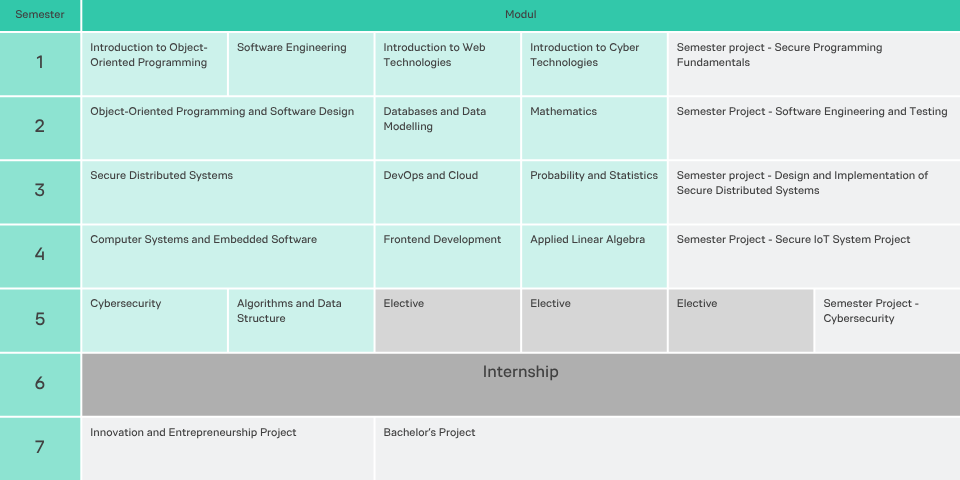
    Overview of semesters at Software Technology Engineering with Cybersecurity speciality 

    The programme is structured as a 3.5-year, full-time engineering programme consisting of seven semesters (210 ECTS).

    1st Semester: Secure Programming Fundamentals

    Introduces foundational programming, object-oriented software development, basic web technologies, software engineering, and introductory cybersecurity. You will learn to build simple software systems and use professional development tools for collaboration, documentation, and version control.

    Semester project: Focuses on secure programming fundamentals. Your team will design and implement a software system with a strong emphasis on requirements, basic system design, input validation, testing, and documentation.

    2nd Semester: Software Engineering and Testing

    Strengthens your competencies in advanced object-oriented design, databases, mathematics, and overall software quality. You will learn to model, design, implement, and test modern client/server software architectures.

    Semester project: Focuses on software engineering and testing. You will work intensely with UML-based system modelling, relational databases, design patterns, unit testing, continuous integration pipelines, and agile workflows.

    3rd Semester: Secure Distributed Systems

    Introduces distributed systems, computer architecture, DevOps practices, cloud technologies, and probability and statistics. You will learn how modern software components securely communicate, scale, and maintain consistency across complex networks.

    Semester project: Focuses on the design and implementation of secure distributed software systems. You will implement robust communication protocols, authentication mechanisms, secure architectures, and evaluate system behaviour through statistical data collection.

    4th Semester: Secure IoT and System Integration

    Focuses on full-stack development, combining advanced backend architectures (.NET/C#) and interactive frontends with low-level embedded software design and applied linear algebra.

    Semester project: Focuses on secure IoT systems. You will build a heterogeneous, integrated system connecting backend services, databases, user interfaces, and physical embedded hardware via secure communication protocols.

    5th Semester: Cybersecurity Specialisation and Electives

    Deepens your technical expertise in applied cybersecurity, advanced algorithms, and data structures. You will focus heavily on threat modelling, risk assessment, vulnerability mitigation, and secure system design.

    Semester project: A specialised project combining cybersecurity principles with one or more of your chosen elective areas. Additionally, an internship workshop will prepare you for the corporate world through CV crafting, mock interviews, and technical portfolio presentation.

    Note: Elective course content is currently under development.

    6th Semester: Engineering Internship

    A full-time, 20-week engineering internship within a private company or public organisation in Denmark or abroad. You will step directly into real-world development processes, applying your secure software engineering methodologies to actual industry tasks.

    7th Semester: Innovation and Bachelor Project

    Focuses on cutting-edge innovation, tech-entrepreneurship, and your final capstone project.

    Innovation project: A cross-disciplinary team project utilising frameworks like Design Thinking and Lean Startup to develop innovative digital concepts.

    Bachelor project: A comprehensive software engineering project addressing a complex, real-world industry problem. Typically executed alongside an external company, you will analyse the domain, justify your technological choices, implement a secure solution, and critically evaluate the architectural results.


  • The programme consists of practice-oriented teaching with a mix of classroom lessons and project-oriented work. To the furthest extent possible, we plan the teaching, so that you learn theories through concrete assignments, tasks, cases and projects.

    During the programme, you will work on projects that are increasingly influenced by your own choices.

    Sustainability, digitalisation, innovation and entrepreneurship are central concepts at all of VIA’s engineering study programmes and are implemented in teaching, internships and projects throughout your education with us.

    Theory as well as practical classroom teaching

    Teaching primarily takes place in the classroom. Classes are based on project work with emphasis on problem-based learning. Your lessons vary between theory and practice. This means, that your will learn academic theories of engineering and how to transfer theories to practical tasks, projects, and cases. Project work takes place in teams.

    Each semester is concluded with a semester project in which students get to use the knowledge they gained from all semester courses in one assignment.

    Lab work is an important part of the programme

    Software Technology Engineering has an IoT lab as well as an XR-lab, making it possible to test multiple theories in practice. Exercises in the labs is an important part of the teaching at the programme.

    Company visits and collaboration

    At VIA, we educate engineers in close cooperation with businesses. Therefore, we organise company visits during your studies, at which you can meet fully trained Software Technology Engineers, who will introduce you to their workdays, tasks and the challenges they face during their workdays. By that, you will learn how different companies operate, what the day-to-day tasks are like and what you can expect, when you finish your studies.

    In addition, you will meet guest lecturers from the industry, for example former students talking about their careers and work lives.

    At the sixth semester, you get to do an internship in an industry business, working along side their other employees and letting you practice your skills. 

    Former students as guest teachers

    You will also meet guest lecturers from the business community. For example, it can be former students who talk about their career, working life and work tasks.

    Full time studies with preparation

    Be aware that the programme is full time and requires an average of 40 hours of studying per week.

  • As a student at the Software Technology Engineering Cyber Security study programme, you will share an academic and social bond with your class as well as students from VIA’s other engineering programmes.

    We have a tolerant study environment with young and more mature students from all walks of life. Expect to meet international students from all over the world, as well as Danish students seeking an international outlook on their education.

    Campus Horsens

    When you are not studying, there will be plenty of other things to do at campus. At VIA, we have a lot of different associations, which you are more than welcome to join. We have social, academic, and political associations, or you can join the social life at Friday bars, parties or by playing board games in the afternoon. Learn more about activities on and off campus here.

    In addition to social activities, we also help students wanting to start their own business in VIA Student Incubator, as well as career counselling in the Career Centre. 

    Campus Horsens has an international student environment with students from all over the world.

    Read more about all the facilities and services Campus Horsens has to offer here!

    Or, if you need more information on life in Denmark, for example on how to find housing, go to our life in Denmark section!

    Study start

    During the first days of your first semester, you will be introduced to your study programme and the study environment at your new campus. Study start is comprised of both academic introduction to your programme as well as social activities, where you get to know your fellow students. Furthermore, you will get an introduction to Campus Horsens and the city of Horsens.

    As a part of study start, you will meet your lecturers, student counsellors and tutors. They are all ready to answer your questions and tell you about your new study programme. An experienced student from the Software Technology Engineering programme will be assigned to you as your main tutor and help you settle in your new role as a student at VIA.

    The Cybersecurity Engineering programme has study start in early February, but the final programme and dates will be announced at MyVIA, VIA’s portal for students. You will get access to the site once you are enrolled.

  • Living Costs

    You should expect average monthly living costs between DKK 6500 and 7500 (roughly 875 - 1000 EUR), including accommodation. More about living costs in Denmark here!

    Financial support

    SU is a monthly grant provided to students by the Danish government. Provided that they fulfil a number of requirements, e.g. having a contract for 10-12 work hours per week, EU citizens may also be eligible for SU. More information about SU for foreign students and how to apply.

    Scholarships

    At VIA, we do not offer financial support options to tuition-paying international students from outside the EU/EEA. Learn more about tuition fees here.

  • Curricula and other documents are under development and will be posted here as soon as possible

Internship 

The Software Technology Engineering with Cybersecurity study programme includes a 20-week internship at the 6th semester. Here, you will get the chance to test the skills you have learnt at the programme in practice.
  • You can take your internship in a company or organisation of your choice. As software development is used in many industries and developers are generally in high demand, you are able to find internship placements in most industries depending on your interests.

    With the cybersecurity speciality, you can look for an internship placement in practically any industry, as software powers modern society and security is critical whereever data, cloud platforms and connected devices exists. Here are a few examples:

    • The financial sector
    • Defence and security
    • Cybersecurity and IT security companies
    • The energy and utility industries
    • Consulting companies
    • Healthcare
    • Industrial automation
    • Transport and logistics
  • In your internship, you will get a taste of what it is like to work as a software engineer. You can put your academic knowledge to the test and learn how to apply it in practise. At the same time, you can start building a professional network in the industry.

    Internship provides experience

    During your internship, you will solve assignments and tasks at equal footing with other employees. As you build your skill set, you will typically gain more and more responsibility for your own projects and assignments.

    In the internship, you get to test your engineering skills as well as skills in e.g. communication, time- and project management, innovation, teamwork and last, but not least, get an understanding of what it is like for a software engineer to be a part of a work place.

    Internship guidance

    You will be assigned an internship supervisor from VIA, who will help make sure that you get a great internship. In addition, some internship hosts pair you with an experienced colleague, who can provide professional guidance and supportduring your stay.

    Finances during your internship

    Internship hosts are not required to pay their interns, but many, especially companies in the private sector, do so anyway. The amount varies from company to company, but the intern salary recommended by the Danish Engineering Union (IDA) is 16,200 DKK/month.

    If you are not paid and you are eligible for SU, you will continue to get this during your internship.

  • You are responsible for finding an internship host yourself. However, you will get support from VIA for the process.

    We work closely with local businesses in Horsens, but have contacts all over Denmark. In addition, VIA's Career Centre is also able to help you with contacts in Danish companies as well as companies abroad if you want to take your internship in another country. They are also able to assist you with your CV and provide support in the application process.

    If you are planning to live and work in Denmark after graduation, we recommend that you take your internship here, as you will get to build your network and get relevant experience from a Danish workplace.

Job and career

At VIA, we educate engineers in collaboration with the industry, and through out your education you will be in contact with companies, who might become your future employer, enabling you to take on practical work tasks from day one.

  • With a Bachelor of Engineering (B.Eng) degree in Software Technology Engineering with Cybersecurity Specialisation from VIA, you will carry a comprehensive toolkit into the global job market. You will possess broad engineering, personal, and business skills alongside elite, specialised competencies in secure software development, distributed architectures, cloud security, and embedded data protection.

    Your versatile skill set prepares you for roles in software development, secure programming, computer technology, cybersecurity analysis, system validation, quality assurance, and IT strategy. You will be uniquely equipped to build digital architectures where reliability, data privacy, and systemic robustness are paramount.

    Cybersecurity has shifted from a niche domain to a foundational requirement of all digital development. Because we educate our engineers in close, continuous collaboration with the industry, you will be fundamentally oriented toward your future employers from day one and will be ready to meet the challenges of the software and cybersecurity sectors head-on.

  • Direct access to master's degree programme

    The Cybersecurity Engineering programme gives you a strong foundation for continuing your studies at master’s level.

    A particularly important opportunity is the direct access to Aarhus University’s Master of Science in Engineering in Computer Engineering. The programme is designed to support progression into advanced graduate studies within computer engineering, software engineering, and cybersecurity, At Aarhus University, the MSc in Computer Engineering allows students to choose between 11 different specialisations, including Cybersecurity, Software Engineering, AI & Computer Vision, Communications and Networks, Cyber-Physical Systems, Robotics and Drone Technology, and several other advanced engineering fields.

    At the same time, the programme also prepares you for other master’s programmes at universities in Denmark and abroad. Your background in software engineering, secure system design, distributed systems, cloud technologies, algorithms, mathematics, and applied cybersecurity gives you a strong academic profile for further studies within areas such as computer engineering, software engineering, cybersecurity, computer science, data science, and related technical fields.

    In other words, you can use your degree from VIA both as a direct path into the job market and as a strong stepping stone towards advanced studies at Aarhus University, other Danish universities, or international master’s degree programmes.

  • As a software engineer specialised in cybersecurity, your job prospects span everything from massive multinational tech enterprises to specialised security consulting firms. Because software powers modern society and security is critical wherever data, cloud platforms, and connected devices exist, you can apply your engineering skills across practically any industry:

    • The financial sector:
      Developing secure digital payment architectures, utilising data analytics and machine learning for fraud prevention, and constructing resilient customer-facing banking platforms.
    • Defence and security:
      Engineering critical, zero-trust IT infrastructures for mission planning, tactical communication, threat monitoring, and secure information exchange.
    • Cybersecurity and IT security firms:
      Working directly with penetration testing, vulnerability analysis, secure code auditing, incident response, and strategic security advisory services.
    • The energy and utilities sector:
      Securing intelligent industrial control systems (SCADA), programming secure IoT components, and protecting the smart grids driving the green transition.
    • Consulting and advisory services:
      Helping organisations securely digitalise, designing robust cloud migrations, and improving overall software lifecycle security and quality.
    • Industrial automation:
      Engineering secure software for robotics, advanced manufacturing systems, embedded devices, and protected machine-to-machine (M2M) communications.
    • Healthcare and welfare technology:
      Developing software for interconnected medical devices, securing patient data management platforms, and safeguarding sensitive personal health data.
    • Transport and logistics:
      Designing secure communication frameworks for autonomous vehicles, safeguarding intelligent traffic systems, and protecting global logistical planning software.

    Entrepreneurship

    You will not be limited to established corporate roles. Many VIA engineering graduates choose to launch their own tech startups or specialised security consultancies. VIA actively supports budding founders through the VIA Student Incubator, offering tailored business counseling, mentoring, and networking opportunities to help turn your secure digital solutions into a viable business.

  • A typical salary for graduates is 40,800 dkr/month.

    With 10 years of experience a typical salary is upwards of 54,600 dkr/month.

    Source: Uddannelseszoom

  • The Career Centre at VIA's Campus Horsens offers a range of career services to students. You can book a counselling session for advice on how to write a great CV or cover letter, updating your LinkedIn profile or how to look for jobs and internships in Denmark. 

    The Career Center regularly organises events and workshops where you can meet company representatives face-to-face in order to find a job, internship, project work or a full-time job related to your field of study.

    More about Career Center

Contact

  • For questions regarding admission requirements and enrolment – contact our admissions counsellors at studieservice.info@via.dk or chat with us here. We are usually available on the chat weekdays from 9-11 am.

  • For questions regarding the Software Technology Engineering - Cyber Security study programme and academic content, please contact:

    Richard Brooks
    Associate Professor
    RIB@via.dk
    T: +45 87 55 44 18

  • VIA Software Technology Engineering
    Campus Horsens
    Banegårdsgade 2
    DK - 8700 Horsens

    +45 87 55 00 20
    horsens@via.dk

    Find us at Google Maps

    Opening hours

    Phones are open:
    Monday - Thursday 7:30 am – 3:30 pm
    Friday 7:30 am – 2:30 pm